The GRC Evidence Collection Gap: Five Business Risks You're Already Paying For
GRC teams know this scene: auditor sends evidence request Friday afternoon and needs a response Monday morning. The request crosses three cloud environments, two acquired companies, and systems your teams didn't know existed six months ago. Your analyst starts opening tickets.
What changed wasn't the request — control evidence has always been central to SOC 2, ISO 27001, and PCI audits. Rather, what changed was the infrastructure. Multi-cloud deployments, microservices architectures, non-human identities, and acquisition integration timelines turned evidence collection from a manageable quarterly exercise into continuous firefighting.
The Business Cost of Manual GRC Evidence Collection
The business cost of manual GRC evidence collection shows up in five ways:
- Security risk exposure from control drift when gaps between documented policy and deployed reality remain undetected until quarterly reviews or during incident response.
- Audit preparation cycles that stretch from weeks into months.
- Analyst burnout from constant context-switching between frameworks and systems.
- Board-level risk exposure when evidence requests can't be answered in regulatory timeframes.
- Revenue velocity constraints when GRC becomes a deal blocker, with enterprise sales stalling on security assessment responses that require weeks instead of days.
After implementing agentic GRC middleware for automated evidence collection, a Fortune 500 financial services company security compliance manager reported: "We were able to reduce our time on audit prep by 80% in the first quarter."
Between regulatory timelines, customer security questionnaires, and quarterly audit check-ins, GRC teams now run multiple parallel evidence-gathering operations simultaneously. The number of systems those teams pull from have expanded between 2023 and 2026.
Traditional GRC platforms like ServiceNow IRM, Archer, Optro (previously known as AuditBoard), and LogicGate all function as systems of record: repositories for findings, workflow engines for audit management, dashboards for executives. Those platforms assumed evidence would arrive ready for consumption. But the collection, normalization, and continuous refresh of that evidence across complex operational systems means that manual processes can no longer keep up.
Five Forces Straining GRC Evidence Collection Capacity
Five converging dynamics exposed the limits of manual evidence collection between 2023 and 2026.
Infrastructure and Architecture Proliferation
Multi-cloud deployments run AWS, Azure, and GCP in parallel. Microservices can route single transactions through 40 distinct services. Infrastructure-as-code pipelines deploy hundreds of ephemeral resources daily. M&A adds entire technology estates overnight. Evidence now exists in thousands of endpoints, many living less than an hour.
CSPM and SSPM tools address parts of this complexity by monitoring cloud configurations, detecting drift, and identifying misconfigurations. But they generate security findings, not compliance evidence. The gap is translation: converting CSPM/SSPM alerts into structured evidence that satisfies SOC 2 access control requirements, ISO 27001 configuration management controls, or PCI DSS hardening standards. Organizations need infrastructure that connects security posture signals to compliance control verification.
The human cost: GRC analysts become ticket coordinators, opening requests in five different systems to assemble evidence for a single control, while the senior engineers who knew where legacy system logs lived are retiring, taking that knowledge with them.
Stakeholder and Reporting Demands Expansion
SEC incident disclosure rules enforce four-business-day timelines. State regulators want privacy compliance proof. Cyber insurers require control evidence before policy renewal. Enterprise customers send 200-question security assessments before contract signature. Boards expect quarterly risk updates formatted differently from what auditors need.
GRC teams have become translation services that provide the same evidence scoped, formatted, and delivered on incompatible schedules to stakeholders who each assume they're the primary audience. Sales need a security assessment answered in 72 hours to close a deal. Legal needs SEC-ready incident evidence in four business days. The CFO needs cyber insurance renewal documentation six weeks before policy expiration. Miss any one deadline and the cost is a lost deal, a regulatory violation, or an uninsured risk event.
Verification Timeline Compression
Annual audits gave way to continuous audit models. SOC 2 auditors schedule quarterly check-ins, moving from annual attestation toward continuous assurance. Access reviews that ran yearly now execute monthly because workforce churn demands it. Gartner calls this "continuous controls monitoring" (CCM) and "perpetual audit readiness": the capability to generate audit-quality evidence on demand, any day of the year, without sprint-style preparation cycles. The SEC's 4-day disclosure rule means real-time evidence readiness for Board reporting — not "we'll compile it when the auditor arrives." Point-in-time snapshots fail when the question becomes "what was your control state the day of the incident?" The calendar compression forces a choice: hire more analysts to handle the volume, or build evidence infrastructure that makes evidence collection continuous rather than event-driven.
Identity and Access Complexity Growth
Access control once meant employees with Active Directory accounts. Now access control needs to manage service accounts, API keys, OAuth tokens, GitHub Actions workflows, AI coding assistants with persistent repository access. Non-human identities (NHIs) outnumber human ones in most organizations. Recent data shows NHIs grew 44% from 2024 to 2025, now outnumbering human identities at 144 to 1, up from 92 to 1 in 2024. Zero Trust architectures turn every API call into an authorization decision that might need evidencing. The IAM evidence has become more granular and more heterogeneous.
The compliance challenge: auditors still ask "who has access to customer data?" but "who" now includes 10,000 service accounts, 3,000 API keys, and 500 OAuth applications — none of which show up in the quarterly access review pulled from Active Directory. Manual tracking doesn't scale as spreadsheets tracking non-human identities go stale very fast. The risk exposure grows when those credentials don't expire, don't trigger offboarding workflows, and remain active years after the developer who created them left the company.
Manual Process Structural Failure
Remote contractors don't connect to VPNs, so traditional collection methods miss them. Organizations run SOC 2, ISO 27001, and PCI audits concurrently, with three auditors requesting identical evidence phrased three different ways. Manual processes simply don't scale across complexity, volume, and velocity simultaneously.
How Continuous Controls Monitoring (CCM) Evolved to Meet These Challenges
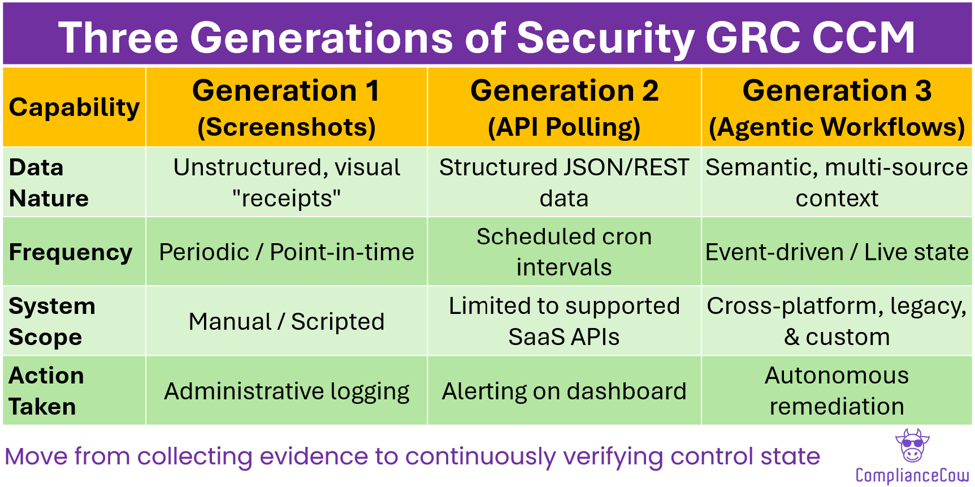
Continuous Controls Monitoring solutions evolved through three distinct generations to address evidence collection at scale.
CCM Generation 1: Scheduled Screenshots
The first generation captured evidence through scheduled screenshots at fixed intervals: weekly or monthly snapshots of system configurations, access lists, or security settings. Better than fully manual collection, but someone still needed to review, organize, and contextualize artifacts after capture. Evidence remained unstructured visual "receipts" tied to point-in-time collection windows. GRC analysts traded manual screenshot capture for manual screenshot organization.
CCM Generation 2: API Polling
The second generation added API integrations pulling structured JSON/REST data from supported systems on scheduled cron intervals. More efficient than screenshots and producing machine-readable data, but still periodic rather than continuous, and limited to systems with compatible APIs. Evidence improved from visual artifacts to structured data, but collection remained tied to fixed schedules and supported SaaS platforms. The gap: legacy systems, custom applications, and on-premise infrastructure didn't expose APIs that Gen 2 tools could poll.
CCM Generation 3: Agentic Workflows
The third generation is where ComplianceCow's evidence infrastructure middleware operates. It uses agentic workflows with autonomous agents that:
- Collect data across diverse systems (cloud, on-premise, legacy, custom).
- Perform controls testing against current conditions.
- Identify compliance and risk gaps through continuous analysis.
- Trigger remediation workflows when drift is detected.
The data becomes semantic, with multi-source context. Collection changes from scheduled intervals to event-driven, live-state verification. System scope expands from supported SaaS APIs to cross-platform environments including legacy and custom systems.
The fundamental transition: from periodic evidence capture to continuous validation and autonomous response against live system state.
This evolution mirrors the broader shift from policy-based compliance (proving you have the right documentation) to evidence-based compliance (proving controls operate effectively in production). Generation 3 CCM's agentic GRC workflows powered by ComplianceCow's centralized evidence layer provides the infrastructure that makes evidence-based compliance operationally feasible.
The analyst impact: instead of opening tickets and waiting for engineers to respond, GRC teams configure autonomous agents that continuously verify control state. Instead of assembling evidence manually during audit prep, analysts review pre-collected, timestamped verification data. GRC's role shifts from evidence coordinator to risk analyst — the work GRC professionals were hired to do.
Centralized Automated Evidence Layer: GRC Middleware Architecture
GRC middleware extends existing Integrated Risk Management (IRM) platforms rather than replacing them.
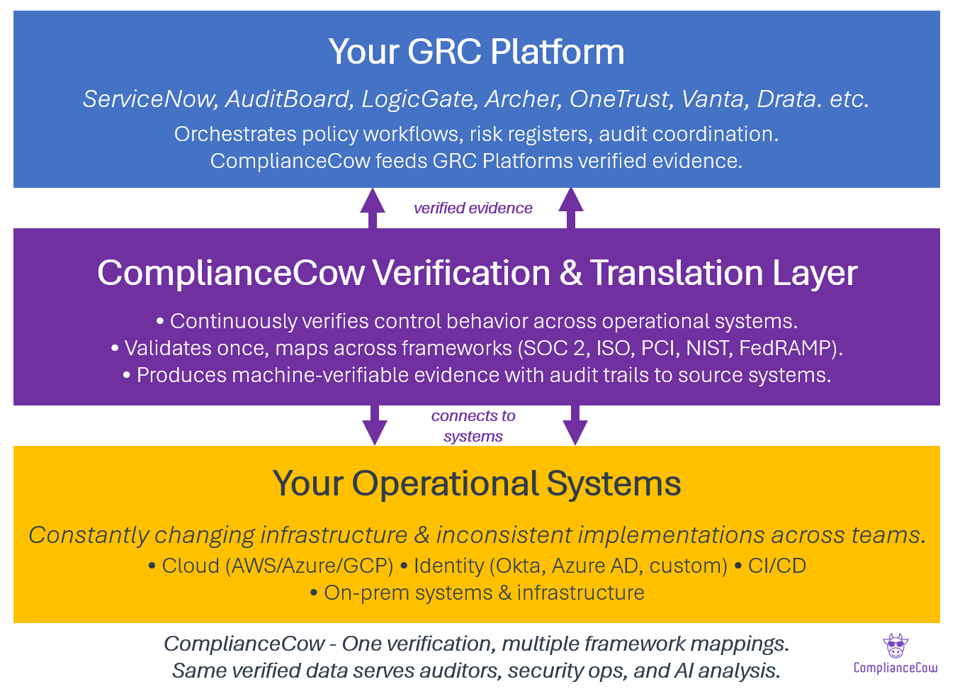
Organizations running ServiceNow IRM, Archer, Optro, or LogicGate face a common challenge: these platforms excel at workflow management, findings tracking, and executive reporting, but weren't architected to continuously pull evidence from the diversity of on-prem, proprietary, and modern cloud infrastructure. ComplianceCow's centralized automated evidence layer fills that gap, feeding IRM systems with structured, real-time data from complex operational environments.
The architecture sits between operational systems and GRC platforms. Consider it an evidence API: it connects to your complex hybrid environment (cloud systems, on-premise infrastructure, Kubernetes clusters, SaaS applications, custom controls), continuously collects and normalizes evidence, and makes that evidence available to any consumer — including auditors, GRC platforms, security operations, and AI-driven workflows.
Centralized Automated Evidence Layer: Core Capabilities for GRC Teams
GRC middleware that extends existing Integrated Risk Management (IRM) platforms needs six core capabilities.
Automated Evidence Collection Serving All Frameworks Simultaneously
One collection cycle satisfies SOC 2, ISO 27001, PCI DSS, NIST 800-53, and HIPAA requirements without redundant manual effort. ComplianceCow's unified cross-control mapping combines controls from multiple frameworks into one operational fabric, simplifying audits and reducing mapping overhead. The same access control verification satisfies SOC 2 CC6.1, ISO 27001 A.9.2.1, and PCI DSS Requirement 7 simultaneously.
Programmatic Evidence Generation from Live Infrastructure State
For PCI access control requirements or SOC 2 quarterly prep, ComplianceCow's evidence infrastructure queries live infrastructure state and produces structured, timestamped evidence. Deeper collection capabilities fetch, stitch, and package evidence from multiple systems, creating reusable artifacts across frameworks. The evidence includes not just "here's the current state" but "here's the verification history for the past 90 days with timestamps and change detection."
Third-Party Access Log Collection Across Heterogeneous Sources
Surfaces which vendors, contractors, and service accounts accessed what resources across all evidence sources. Particularly valuable when tracking non-human identities that traditional discovery methods miss. ComplianceCow's agentic workflows can correlate API keys created in AWS, service accounts provisioned in GCP, and OAuth tokens issued by SaaS applications — evidence that would require opening tickets in three different systems using manual methods.
Custom Control Enforcement Verification Through Scheduled Automated Checks
Confirms vendor MFA enforcement or organization-specific requirements automatically. ComplianceCow's continuous verification monitors controls through automated checks and scheduled reviews, maintaining real-time compliance visibility. When a control drifts out of compliance — MFA disabled on an admin account, encryption turned off on a database — the system detects it within hours, not during the next quarterly review.
Automated Access Expiry Workflows with Configurable Remediation Speed
Detects stale access and triggers automated remediation before it surfaces as an audit finding. Organizations choose remediation speed: fully automated, guided workflows with approvals, or intelligent ticketing. The GRC team sets the policy ("service accounts inactive for 90 days should be disabled") and ComplianceCow's agentic workflows execute the verification, identification, and remediation without manual intervention.
Audit Trail API Response Generation for Regulatory and Internal Consumers
Provides machine-readable, timestamped evidence for regulators, auditors, or internal investigations. Outputs integrate with GRC platforms including ServiceNow IRM, Archer, Optro (aka AuditBoard), and LogicGate. When the auditor asks "show me all administrative access to production systems in Q3," the response is API-generated within minutes, not assembled over two weeks.
This evidence infrastructure middleware architecture addresses the five convergence pressures directly:
- The exploded evidence surface: ComplianceCow's connectors reach all heterogeneous sources.
- Multiplied consumers: one collection cycle serves them all.
- Compressed timelines: continuous collection enables real-time readiness.
- Deepened complexity: automated logic tracks non-human identities manual reviews overlook.
- Broken manual processes: direct infrastructure queries eliminate engineering tickets.
Evidence-Based Security Compliance: From Policy Documentation to Operational Proof
GRC leaders are moving from policy-based compliance to evidence-based compliance models.
The Transition from Policy-Based to Evidence-Based Security Assurance
Traditional GRC operated on policy-based compliance: organizations demonstrated control effectiveness by producing policies, procedures, and process documentation. Auditors sampled evidence quarterly or annually to verify those policies were followed. The compliance artifact was the policy binder.
Evidence-based compliance inverts this model: controls generate continuous, programmatic evidence of their operation. Rather than "we have a policy requiring MFA," the assertion becomes "here is timestamped verification that 99.7% of authentication events enforced MFA across all systems for the past 90 days." The compliance artifact isn't the policy document — it's the operational proof. ComplianceCow's evidence infrastructure middleware provides that operational proof through continuous verification against live system state.
The SEC's incident disclosure requirements, cyber insurance underwriting changes, and customer security assessment volume all push organizations toward evidence-based compliance. Cyber insurers increasingly require evidence of control operation — not just policies stating controls should exist — before underwriting coverage. Customer security assessments ask "prove your encryption is enabled" rather than "do you have an encryption policy?"
This transition requires infrastructure that continuously collects, normalizes, and timestamps evidence from live systems, which is the architectural challenge ComplianceCow's centralized evidence layer addresses through Generation 3 agentic workflows.
How AI-Enabled GRC Depends on Better Verification Infrastructure
Current AI applications in Security GRC concentrate on documentation: drafting policies, summarizing frameworks, answering compliance questions. Useful work, but it operates at the reporting layer with evidence humans already collected.
For AI to function at the verification stage — evaluating whether controls remain effective — it requires structured, machine-readable, continuously refreshed, traceable evidence. It needs live operational state, not screenshots and PDFs. ComplianceCow's centralized evidence layer provides that structure through agentic workflows that continuously verify control state. When evidence exists as timestamped, governed data with audit trails, AI can evaluate control effectiveness, identify drift between policy and deployed reality, and surface anomalies warranting human investigation.
AI in Security GRC won't become transformative because prompts improved. It becomes transformative because underlying systems — the evidence infrastructure middleware like ComplianceCow — improved at pulling evidence from live operational systems, evaluating it through governed control logic, and turning it into structured, traceable control state. Strengthening the verification and evidence data layer is how organizations prepare for more AI-capable Security GRC futures. It's also how they solve their immediate problems of evidence collection being unable to keep pace with operational reality.
The ROI appears in multiple dimensions:
- Reduced audit preparation time (the 80% reduction one company achieved).
- Risk mitigation from continuous verification catching control drift before it becomes an audit finding or compliance violation.
- Faster incident response when evidence is available within hours instead of weeks.
- Revenue velocity — GRC is never a deal blocker because security assessment responses take hours, not weeks.
- Decreased analyst burnout from eliminating repetitive coordination work.
Assessing Your Current GRC Evidence Collection Layer
The security GRC evidence challenge has evolved very quickly. Today's security GRC evidence scale and velocity is far more complex than your GRC platform was designed for.
The question becomes: can the process layer feeding that IRM platform handle multi-cloud environments, non-human identities, continuous auditing, and simultaneous compliance frameworks without exhausting your team?
For most organizations, the answer is no — the process layer remains too manual, and institutional knowledge is walking out the door with retiring engineers.
Planning for future audits, SEC reporting requirements, customer security assessments, and Board updates requires asking: do we have evidence infrastructure, or evidence improvisation? The difference determines whether GRC becomes a bottleneck for revenue, regulatory compliance, and risk transfer — or whether GRC becomes an enabler that answers stakeholder questions in hours instead of weeks.
Organizations implementing ComplianceCow's evidence infrastructure middleware report consistent outcomes:
- A Fortune 500 fintech automated 16 PCI controls and reduced human hours by roughly 80%, scaling quarterly compliance reviews without adding headcount.
- A Fortune 100 streaming company eliminated duplicative manual data entry from vendor risk workflows, renewing ComplianceCow at roughly half the cost of a single engineer.
- A Fortune 100 networking leader closed recurring audit exceptions from delayed contractor deprovisioning and achieved centralized compliance visibility across dozens of independent Jira environments — without disrupting engineering workflows.
The infrastructure investment transforms GRC from reactive firefighting to proactive risk management and changes GRC work into the strategic function leadership expects from their program.
What to Assess This Week: Three GRC Evidence Diagnostic Questions
Here are three measurements that help reveal whether your evidence collection operates as infrastructure or improvisation.
1. Map Your Evidence Collection Labor Hours
Ask your GRC team to track time spent on evidence collection mechanics this week: opening tickets to engineering, following up on pending requests, organizing artifacts into audit-ready formats, translating the same evidence between framework requirements.
Calculate the percentage of total GRC analyst time consumed by coordination rather than risk analysis. When coordination work dominates analyst capacity and leaves little time for risk evaluation, control design, or strategic advising, your evidence layer has become the bottleneck rather than the enabler. Organizations implementing evidence infrastructure middleware report coordination work shrinking to a minor fraction of GRC analyst time, with capacity redirected toward strategic risk work.
2. Inventory Your Non-Human Identity Coverage
Pull your most recent access review documentation. Count how many service accounts, API keys, OAuth tokens, and automation credentials appear in that review versus how many exist in your AWS, Azure, GCP, and SaaS environments.
The gap between documented and actual non-human identities represents unmanaged risk exposure. In most organizations, access review processes designed for human identities fail to capture the full population of service accounts and API credentials. That leaves serious security gaps: credentials that don't expire, don't trigger offboarding workflows, and remain active years after their creators left the company. Evidence infrastructure that continuously discovers and tracks non-human identities across heterogeneous systems will surface that hidden population.
3. Measure Your Evidence Response Time
When the next stakeholder evidence request arrives — from an auditor, customer security assessment, Board member, or regulator — timestamp when the request came in and when you delivered complete evidence.
Questions about current control state ("how many admin accounts have MFA enabled today?") reveal whether your evidence collection operates reactively or continuously. If assembling that evidence requires opening tickets and waiting for responses, you're operating reactively. Organizations with continuous verification infrastructure answer these questions rapidly because the evidence already exists, timestamped and structured, rather than requiring assembly from scratch.
These three diagnostics — labor allocation, identity coverage, response time — indicate how ready you are for the 2026-forward compliance environment. The measurements themselves take hours to complete. The infrastructure decisions they inform determine whether your GRC program scales or stalls.
GRC Evidence Infrastructure: The Case for a Middleware Approach
The five forces described in this article — infrastructure proliferation, stakeholder demand expansion, timeline compression, identity complexity, and manual process failure — didn't arrive one at a time. They converged, and faster than GRC teams organized around annual audit cycles and manual evidence collection were built to handle.
The answer is better evidence infrastructure: a centralized automated evidence layer that sits between your operational systems and your IRM platform, continuously collecting, normalizing, and timestamping evidence so your teams can chase less and analyze more.
ComplianceCow's agentic GRC middleware was built to fill this architectural role. If your evidence collection process isn't scaling, exploring what better evidence infrastructure looks like in your environment is a logical next step.