ComplianceCow's integration with ServiceNow IRM brings automated, continuous evidence collection, controls testing, remediation and graph analysis for cybersecurity controls across complex IT environments. ComplianceCow is a ServiceNow Certified App.
Here are four resources with more information:
- ComplianceCow and ServiceNow IRM Overview
- ComplianceCow and ServiceNow IRM Deep Dive
- From Prompt to Production: Building Automated CCM 3.0 Controls with AI
- ServiceNow Store: ComplianceCow Continuous Controls Management
Let me take a moment to describe what this integration means for ServiceNow IRM customers.
ServiceNow IRM provides the GRC system of record
ServiceNow IRM is used as the governance system of record for risk, controls, issues, policy, audits, exceptions, and remediation. Ownership, review cycles, attestations, issue tracking, and reporting can be managed there in a structured way.
What remains a problem for many enterprises is that governance workflows depend on evidence coming from operational systems, and that gathering the evidence layer is often manual, fragmented, or from only a subset of IT environments.
ServiceNow CCM helps automate control monitoring within supported ServiceNow patterns
ServiceNow CCM can help automate control monitoring within the ServiceNow model and the patterns it supports. That can be useful when monitoring activity can be tied directly to control records, issues, tasks, and reporting workflows inside ServiceNow.
The problem is when security GRC evidence needs to be gathered and validated across hybrid cloud systems, identity platforms, operational technology (OT) environments, cybersecurity tools, on-prem and proprietary applications, and older infrastructure that doesn't present control state in a uniform way.
Complex IT environments create evidence gaps that governance workflows cannot close on their own
In cloud, hybrid, OT, and AI-heavy environments, a single control objective often depends on signals from multiple systems. Screenshots, exports, point integrations, and periodic collection jobs can support bounded cases, though they do not hold up well when control validation has to span heterogeneous environments and fast changing runtime conditions.
Governance workflows can assign owners, track issues, and manage remediation. But governance workflows do not by themselves guarantee current, traceable evidence tied to live system behavior.
ComplianceCow extends ServiceNow IRM with runtime evidence collection and current-state control validation across complex environments
Continuous controls monitoring has evolved from scheduled screenshots to API-based periodic collection. Those approaches can document what existed at collection time, but they cannot adapt when conditions change or act when issues are found.
ComplianceCow represents the next phase: Agentic GRC. However, because AI agents are inherently probabilistic, relying on them to independently evaluate production records creates a serious assurance risk.
To solve this reliability gap, ComplianceCow's approach operates differently by separating design from execution:
Agents assist in control design: GRC teams use natural language to quickly scope evidence requirements, assemble evaluation logic, and map frameworks.
A deterministic runtime automates collection: Once a human validates the design, governed building primitives securely pull data across diverse systems.
The runtime performs consistent controls testing: Approved logic runs deterministically against current conditions, preserving a strict chain of custody for auditors.
Agents analyze gaps and assist remediation: AI reasoning models help identify the context behind compliance failures and recommend specific remediation workflows.
The difference is that agent-assisted design accelerates how quickly you can create controls, while deterministic execution ensures that evidence collection, validation, and response happen continuously, and reliably, against live system states rather than fixed snapshots.
By pairing agent-assisted speed with deterministic reliability, ComplianceCow extends ServiceNow IRM at the evidence layer, ensuring governance workflows are fed by fast, traceable data from across complex and disparate systems.
ComplianceCow automates evidence collection across complex and disparate systems
Through a Declarative GRC model, practitioners can describe their intended control outcomes in natural language. ComplianceCow then uses governed GRC building primitives (like trusted connectors, credential managers, and data normalizers) to automate evidence and data collection closer to the source operational systems. For ServiceNow IRM users, this means:
Controls are continuously reconciled: Approved control logic evaluates current operational conditions directly against your intended declarative state.
Gaps are identified with pinpoint specificity: Because data is collected via trusted primitives, the resulting evidence is deterministic, traceable, and highly defensible.
Outputs are normalized for ServiceNow: The runtime delivers structured, verifiable evidence directly into ServiceNow IRM, where your established governance and remediation workflows already exist.
Critically, ServiceNow IRM remains the system of record. ComplianceCow acts as the missing execution engine. This vastly improves the quality, recency, and defensibility of the runtime evidence feeding those ServiceNow workflows.
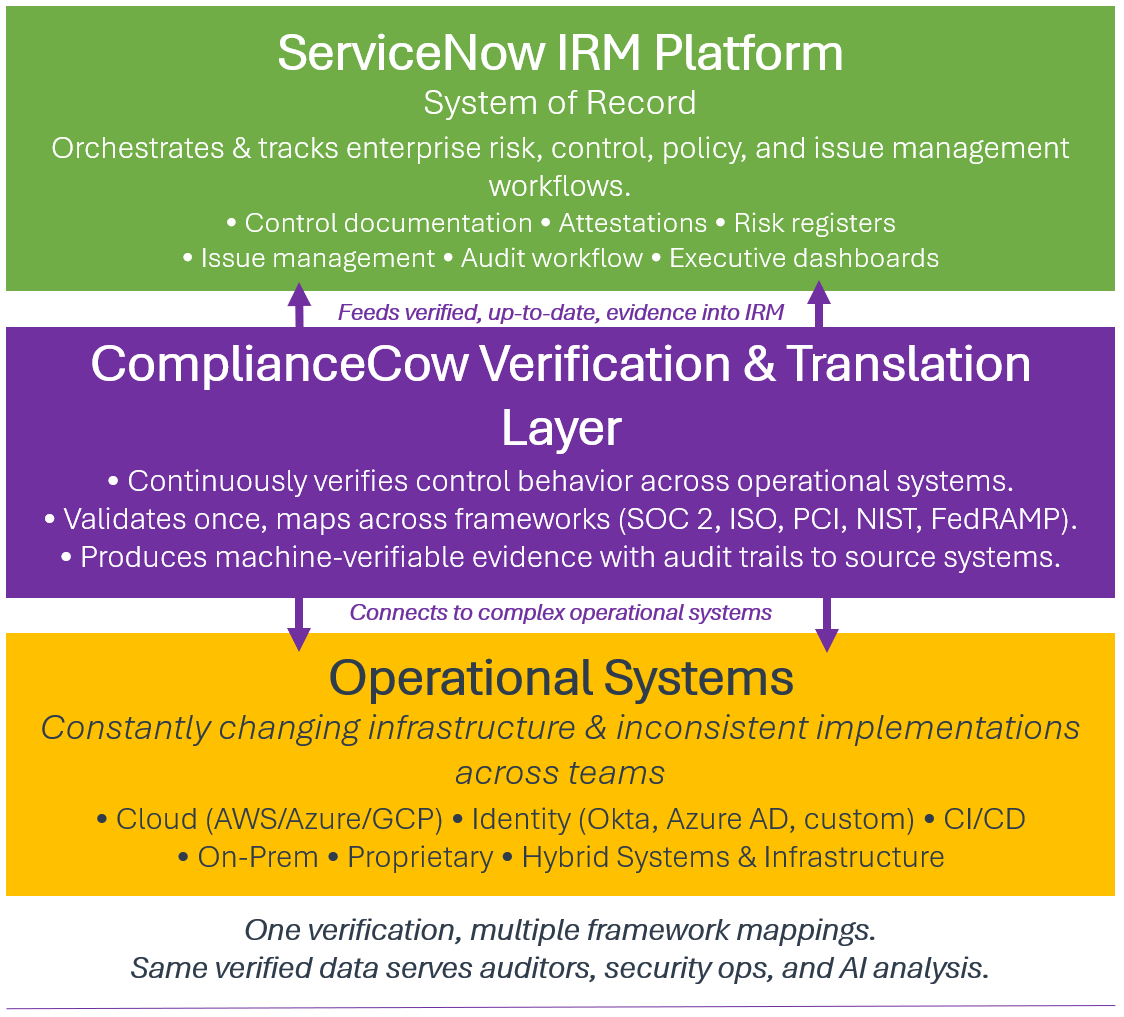
So far I've described how ComplianceCow extends ServiceNow IRM at the evidence layer. That is, connecting to diverse systems and feeding validated evidence into governance workflows.
Now I want to show two specific GRC problems this solves, because the technical architecture addresses operational pain points that GRC teams face daily.
- Policy documents to control monitoring gaps
- Vulnerability assessment across infrastructure and applications
Compliance policy documents do not show which controls are actively monitored
Most enterprises have approved policy documents that describe required controls. Fewer enterprises can answer which of those controls are being monitored right now and which are not.
ComplianceCow's Policy Agent can read static policy documents, assess monitoring coverage, surface when controls were last run, and identify compliant or non-compliant resources. That information can then be used inside the ServiceNow experience, including through AI Studio.
We think the value is straightforward. Policy language can be connected more directly to monitoring coverage, which gives GRC teams better visibility and gives leadership a stronger basis for sign-off.
The risk of not having that visibility is concrete. In October 2023, the SEC charged SolarWinds and its CISO Tim Brown with fraud and internal control failures related to the 2020 SUNBURST cyberattack. The case centered on gaps between written policy commitments and actual enforcement, which is exactly the problem ComplianceCow's Policy Agent addresses.
Critical vulnerabilities require auditable exposure assessment across infrastructure and applications
On April 7th this year, Anthropic released Project Glasswing in preview, partnering with Microsoft, NVIDIA, Apple, and AWS to uncover critical zero-day vulnerabilities that had existed undetected for years. Events like this put immediate pressure on compliance and risk teams to assess enterprise exposure quickly and accurately.
Severity headlines do not answer the main enterprise question, which is whether exposure exists in the environment and whether a given vulnerability is exploitable under present conditions.
ComplianceCow helps audit exposure across diverse infrastructure and proprietary applications so that compliance and risk teams can work from a more grounded picture of current posture. ServiceNow IRM can then be used to govern issues, assignments, remediation actions, and reporting.
That shifts GRC analysts from evidence clerks to domain experts who can distill signal from noise and improve the efficacy of security operations teams.
The Log4j incident in late 2021 showed what happens when GRC teams lack that capability. Teams were pressured to assess exposure across entire infrastructure estates without tooling to audit whether vulnerable versions existed in their environments or whether those instances were exploitable under current configurations. ComplianceCow helps GRC teams answer those questions with up-to-date and traceable evidence rather than educated guesses. This also shifts compliance left, catching control gaps and configuration issues earlier in development cycles rather than discovering them during audits or after deployment.
Continuous controls monitoring improves GRC operating efficiency and risk assessment frequency
Governance workflows become more useful when the evidence feeding them is more current, more traceable, and more closely tied to live system behavior. Manual GRC effort is reduced. Audit effort is reduced. Risk assessments can be run more frequently without proportional cost increase. Automated and semi-automated controls can be deployed faster.
Customer results using ComplianceCow
Customers are seeing substantial savings in time and resources.
- 80% Reduction in GRC effort
- 20% Savings in internal and external audit effort
- 15x Increase in risk assessment frequency without increased cost
- More than $3M in annual productivity savings for first- and second-line teams in enterprises with 5,000 or more employees
- Reduction in deployment time for automated and semi-automated controls, from months to days, and in some cases hours
These real-world results show what is possible.
ServiceNow IRM becomes more useful when governance is fed by current, traceable evidence
When ServiceNow IRM can receive reliable, traceable and more up-to-date evidence inputs, then GRC decisions, issues, remediation, and reporting improve by having current control state rather than using aged, periodic artifacts.
With our integration with ServiceNow IRM, ComplianceCow provides that reliable and faster evidence pipeline across diverse and complex systems.